Showing posts with label technique. Show all posts

The One Who Taught Us


0 comments

It's always interesting, when reading books that have nothing to do with cycling what so ever, to come across such passages, casually thrown in. The world of bicycles permeates the text suddenly and then, just as abruptly, it is abandoned. It was, after all, only a snippet. A literary device. Usually a means of conjuring up a childhood memory, replete with symbolism.

Oddly enough I've stumbled upon these types of narratives in several completely different books I've recently read. Each time the passage had to do with learning how to ride a bike - or, more precisely, with the person who taught the author how to do so.

This makes me wonder whether most people - whether they go on to be cyclists in their adult lives or not - have such a memory, and similarly to these authors, feel the incident to be somehow pivotal to their life story. Is it an important memory, the kind of which we have a very vivid sensory recollection? Does it serve to illustrate either the character of the teacher, or the relationship between them and the fledgling cyclist? Furthermore, are there specific persons who tend to play this role in our lives? When I surveyed my friends, grandfathers and uncles made repeat appearances.

Reading and listening to the stories of others, I realise I may be an anomaly. No one taught me how to ride a bicycle. I figured it out myself, on a borrowed bike, alone, in a city park. New York City in springtime. Saturday afternoon. Cherry blossoms. Orthodox Jews strolling. Children's squeals in Spanish from the swings and monkey bars. And me, apart from it all, a clumsy curious child with messy hair, wearing something stripey, made of a terrycloth fabric. I do have a vivid memory of it, and in particular, of the moment I went from pushing off and coasting for several seconds at a time, to knowing, with a breathtaking certainty, that I could keep the bike in motion indefinitely and, aglow with this knowledge, planting my feet on the pedals. This moment went hand in hand with the awareness that no one was there to witness it, to congratulate or encourage, like I'd seen the minders of other children do. But it wasn't a sad feeling. To know that this unbelievable thing I'd just done was my secret only added a layer of depth to the magic.

In retrospect it would have been nice to share a special bond with a family member or older friend through the act of being taught how to cycle. But being my own teacher, however clumsily and haphazardly, makes for a nice memory as well.

PS: text excerpt from Birchwood by John Banville.

Toward a Topographical Fatalism


0 comments
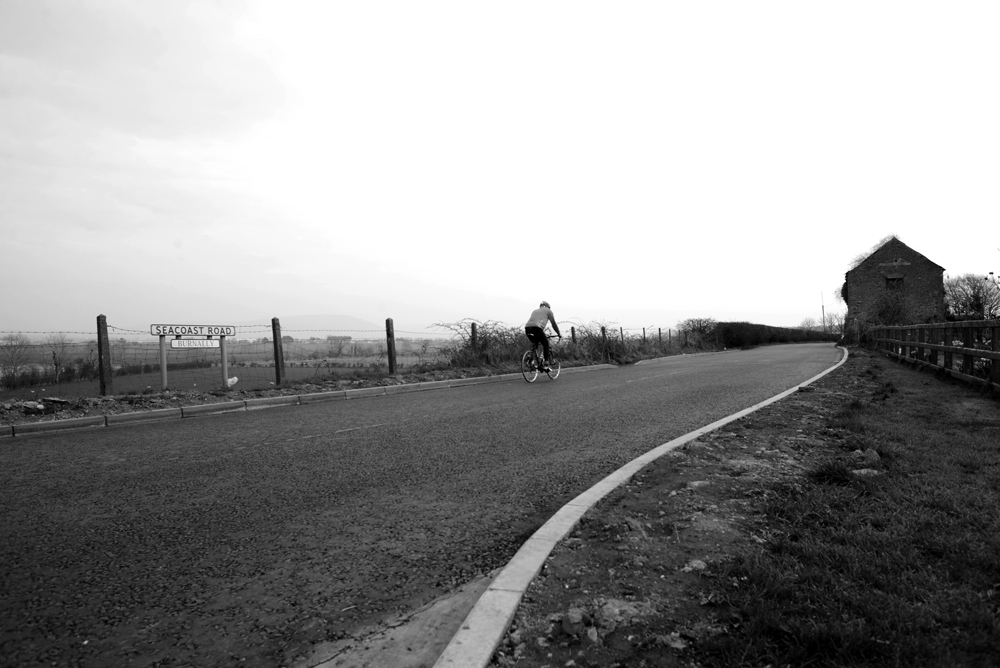
Seacoast Road Cyclist
Without a doubt living in Northern Ireland has changed me as a cyclist. I have noticed. My friends have noticed. But the exact nature of this change is tricky to articulate. It isn't merely a matter of having gotten "better," as defined by improvement in speed and technique. Sure there is that too. After all, how can one not improve with pavement the texture of hard-packed gravel? With a mountain straight out the front door? With winds attacking from every direction? With former racers for cycling buddies? 

But the more fundamental change is in a shift in perspective. I have given in to the landscape. I have stopped approaching difficult topography as a problem - or even thinking of it in terms of difficulty in the first place. The landscape is there, its qualities outside my control. I cannot change it. I can only experience it, appreciate it, remember it. And that is best done if I do not struggle against it, but instead take it as it comes. Rather than suffering through a climb and wishing for it to end, I try to harmonise with it and - believe it or not - enjoy the moment  …or minute, or hour, as the case may be. When approached this way, the reward becomes not the view on top, and not even the sense of accomplishment upon reaching it, but the climb in itself.

Of course it's easy for me to adapt that attitude now that I have a featherweight bike with ultra-low gearing. But it isn't just that either. One day last Autumn I was out with local cyclist and coach Colin Loughery. We were talking about gearing, pedaling technique and strength training. "You want to try something?" he asked. I replied that I did, whereupon he instructed me to accelerate and get into my tallest gear as we rolled down a long flat stretch giving way to a slight incline. "When this flat bit ends," he said, "there will be a drag [hill]. See if you can stay in your tallest gear all the way to the top."

My mood instantly darkened. I didn't look forward to embarrassing myself in front of Colin. But I knew the incline we were about to go up, and there was just no way I could do it in 50/11. Feeling the momentum begin to wear off as I started the climb, my mind raced, grasping for strategies that would at least save me from toppling over. Maybe if I stood right away and pushed with all my might...

But before my butt had a chance to leave the saddle, came Colin's friendly command. "Don't stand! Stay seated and don't change gears. Just pedal." The words coming out of his mouth were so fantastical, that upon hearing them something in me snapped and allowed me to suspend disbelief. Okay, I would pedal. And in this insane gear, while remaining seated, I would crest this hill without breaking my knees or toppling over. 

And then I did exactly that. The strength for it came from somewhere deep within my abdomen rather than from my legs or lungs. It was as if some extra cluster of muscles appeared to accommodate this impossible thing I was trying to do. I could feel it for days afterward. 

"Good. But you stopped pedaling in circles." Colin had said to me at the top. As if, such a normal and casual thing it was to cycle up a hill in 50/11, that we could talk pedaling technique. Circles were the last thing on my mind then ...a pity, as later I discovered that making sure to continue pedaling circles and resisting the urge to stomp makes even grinding feel nicer, more meditative. 

The seeds had already been sewn. But it was on this ride that a philosophy of topographical fatalism took root. Just go with it. Suspend disbelief. The road awaits, and with it the wonderful unknown. 

The Body Remembers


0 comments
I never thought that I would become one of those cyclists with permanent tan lines. But many months since my last ride in shorts the persistent duotone of my legs says otherwise. It is strange to see myself discoloured in this way, to be sporting this roadie badge of honour that I never strove for and do not especially "deserve." Are these legs even really mine?

In fairness, the bulk of the damage was done in the course of a single ride, early last summer: that 300K brevet, when, uncharacteristically, I rode all day in 90°F+ heat and humidity without issue only to, equally uncharacteristically, give up just 30 miles from the finish after night had fallen. This failure hit me with unexpected intensity. After some time I wanted badly to put it behind me, to stop dwelling on the hows and the whys and the what-ifs. But how could I forget an event that left me physically branded? The marks were so prominent, the contrast between the pale and the darkened flesh so dramatic. To make matters worse, everyone around me noticed. "So many miles so early in the summer!" But of course they did not know the real story the tan lines told. All those hours in that insane sun… and all for nothing.

When they don't make me think of the failed brevet, my etched legs make me think of photography. There is considerable overlap between cyclists and photographers, and among these are many film enthusiasts. When you ask those who prefer film over digital to explain why, many will tell you film has a special look that digital simply can't replicate, that film stirs emotions in a way that digital cannot. I do not believe this to be so, and the more I use both mediums the more certain I am there is no such thing as "the look of film" per se. Once you fully and properly control for format, type of lens used, type of film used, aperture and exposure settings, and the myriad of other factors involved, I believe that you can create a digital and a digitised (i.e. viewable on your computer) film image so that the two are indistinguishable to the human eye and emotional palette.

This is not a popular opinion and many film lovers will disagree. But that is beside the point. Because my point is that despite holding this view, I nonetheless prefer film photography over digital. When I want to capture something truly special or meaningful - be it a place, person or event - I shoot it on film. For me it is not about the look, or the quality, or the negative vs megapixel size. It is about capturing a moment and fixing it in physicality; it is about transforming fleeting light into a solid tangible object. The sensual palpability of the silver gelatin process is especially appealing. The baths, the resins, the salts and metals, the "cooking." The photographic process is essentially a printmaking process, and it is the alchemy of it that attracts me. Is this any more valid than the "special look of film" narrative? Maybe not. It's only my way of conceptualising it.

When seen from this perspective, my legs, in a sense, have become photographic objects. Exposure to light produced an etched, physical record of an otherwise fleeting event. Large format. Pigment on flesh. If analogue photography is what I'm after, this is it, in its most basic form.

After a long winter, I am slowly getting back into the swing of roadcycling. The tan lines are covered by long fleecy tights and, considering where I live now, might be for some time. But as I ride, I notice something else that has imprinted on my body. While my fitness level has degraded and my muscle tone's diminished, the technique I have internalised over last summer and all the summers before that have not. On climbs I rise out of the saddle so effortlessly, and on corners I lean so intuitively, that I can hardly believe it was ever otherwise. And then there is that feeling of oneness with the bike that carries with it an animalistically alert-yet-calm sort of confidence that I can hardly put into words. These states of being are etched so deeply, they are of archival quality. The body is analogue and it remembers.

Easy Breezy Squeezy


0 comments
Lately I've been getting a kick out of cycling through tight spaces. You know, like claustrophobically narrow alleys. Skinny gaps between poles. Openings in fences. Interruptions in rows of dense prickly hedges. Doing this opens up a whole new world of shortcut possibilities. And delivers a physical rush from zipping through a gap that, while wide enough to fit me and my bike, is just wide enough and leaves no room for error. Anyone else enjoy this, or am I just being weird?

But it's about more than the fun factor. For me there is great satisfaction in being able to make that "will I fit through this?" judgment correctly, quickly and with reasonable confidence - something that would have been out of the question a couple of years ago.

I've always had problems with proprioception (awareness of the body in space), and in turn, with spatial rotation. I'm the sort of person who routinely bumps into furniture. Who tries to kick a ball and misses. Who ducks for a tree branch that hangs nowhere near low enough to hit my head. Driving a car was always stressful because of this; the detached, abstracted feel of being inside a vehicle distorted my sense of movement in space even further.

There is a unique physicality to being on a bike, that communicates balance, motion and speed in a way that, however slowly, gets through to me. And it is doing more than teaching me new skills. Essentially it is repairing sensory motor deficiencies that I thought were permanent. It is a gradual process, not a quick fix. But year by year, and sometimes even month by month, the improvements are noticeable. Ironically, I would even feel more confident driving after these years of riding a bike.

There are times I think life is complicated. But then I fly through a gap in a fence without breaking stride and feel so happy, that I remember it is not that complicated after all.

The Way We Do the Things We Do


0 comments
A recent bout of flu has activated a marathon knitting session, with nearly everyone in my immediate radius now supplied with a hat or two as a result of my drowsy, sofa-ridden industriousness. I've also started a sweater, which, thankfully, is complicated enough to keep me occupied for days. When fellow knitters see the things I make, they usually ask about the pattern. And my reply is that I don't use a pattern. I know the basics of knitting and sort of improvise from there. I visualise designs in my head and implement them without even sketching anything out on paper. I gauge sizing by looking at a person and guesstimating. The whole process is so intuitive and unconscious for me, that it is almost automated: From conception to completion, I don't pay much attention to what my hands are doing, until - voila- the thing is magically finished, and with some luck, looks and fits as intended.

This approach to knitting has its benefits. However, it also means that I am terrible at explaining to another person how I made a particular garment. It seems so obvious to me, that I find myself saying things like, "well, just - you know - knit a beret shape!" (they: "but… ??!!")

In the midst of such conversations, I am fully aware how frustrating it must be - particularly for a novice knitter - to talk to someone like me. Because that's how I feel talking to anyone for whom cycling is so intuitive, such second nature, that any attempt to break down technique into a step-by-step process is beyond them. "What do you mean how do you climb standing?" such a person might say, "you stand up on the pedals and do it!" Right. Just like you'd pick up the needles and knit a beret.

It may seem that cycling and knitting have little in common. But in fact every productive and performative activity involves, on some level, mastering a sequence of distinct steps. The earlier in life we learn this activity, the more naturally we take to it, and the more frequently we practice it, the less aware we are of those steps - the more seamless and unconscious the sequence becomes. We go through it automatically, unthinkingly, and in so doing we might even genuinely believe that the act is, or "should be," that way for everyone. But the thing is, it might not be. It really might not.

If I consider the way I do the things I do, I realise that cycling is one of the very few activities I do on a regular basis and enjoy doing, where I give any explicit thought to process. Everything else - be it cooking, photography, painting, knitting or dancing - I do on a more unconscious, automated level. Technique is involved, but I've internalised it to the point where it has become invisible unless I really, really force myself to acknowledge it. Maybe over time, it will be the same with cycling. Or maybe it never will. In the meanwhile, I try to be more mindful of the way I explain my process to others, if they ask me questions about activities that to me seem self-evident.
older post