Showing posts with label bicycle reviews. Show all posts

Springing to Life: the Simcoe Roadster


0 comments
Simcoe Roadster
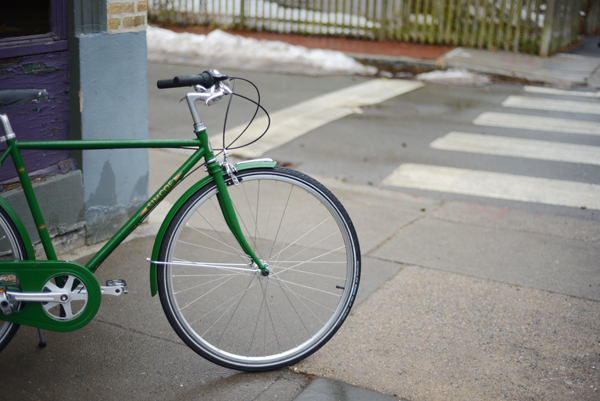
At one point, many of the European city bicycles available in North America were distributed by a company called Fourth Floor in Toronto. Through test riding the bikes they carried, I got to know the guys who ran Fourth Floor and eventually learned they were working on their own line of products. At Interbike 2012 the newly launched Simcoe was unveiled, with a display of prototype bicycles and bags. The idea behind the brand was to make a quality, yet no-frills classic city bicycle, at a reasonable pricepoint. The prototypes looked good, but the final product was not yet ready. By the time Simcoe bikes did become available it was Spring 2014, with a number of other companies promoting a similar concept. Would Simcoe stand out? In the final days of my last visit to Boston, I got a chance to find out, as the Bicycle Belle received a sample of the Simcoe Signature Roadster. We were actually expecting the step-through model, but there must have been a mix-up. No matter. No sooner was the diamond frame assembled that I took it out for a spin.
Simcoe Roadster
When I do a test ride for the blog, I will normally spend some time examining and photographing the bicycle before riding it. But the way this day worked out, I hopped on the Simcoe first, and only after the test ride did I even get a good look at it. So my first impressions were based purely on feel. And these impressions were two-fold. First, this bike felt like a vintage roadster. That mysterious ride quality particular to old English 3-speeds that modern manufacturers can't seem to recreate was there. It was not a cushiness attributable to obvious things like tire width or even frame flex, but to something different, something only those who've ridden bikes like the Raleigh DL-1 and the Humber and the Royal Enfield will understand, while others might be skeptical about (and perhaps rightly so!). Bike construction is not magic and every sensation can be explained if you look hard enough. Probably Simcoe tapped into the right combination of tubing, geometry, wheel rims, et cetera, to achieve this feel - either deliberately or due to sheer luck. Still - subjectively, that intangible "vintage bike feel" was there.

The second thing I noticed while riding the Simcoe, was that it fit me in a way that worked very well for stop-and-go city cycling. It is a long bike with a fairly low bottom bracket. This combination accomplishes several things that I like in a city bike. The low bottom bracket makes it possible to adjust saddle height so as to get full leg extension when pedaling, and also put a toe down at a stop without dismounting. The long top tube combined with the swept back handlebars gives the cockpit a nice roomy feel while allowing for an upright position. The length also prevents toe overlap with the front wheel, as well as "handlebar poke" on turns (the latter doesn't bother me, but some riders complain of it). While I much prefer to ride a step-through for transportation to a diamond frame, I could forgive this bike because it otherwise felt so nice. 

As far as speed, Simcoe describes the Roadster as being "upright yet agile …perfect for short rides through the city, and long rolls through the park." This is pretty much spot on. The bike maneuvers, accelerates and progresses uphill nicely, especially considering its relaxed feel and length. But it is a city bike, so any comments on speed and climbing have to be taken in that context. Compared to other upright city bikes I've tried, it is on the faster end of the spectrum. The 3 speeds on the model I rode felt more than sufficient for the relatively benign hills of Cambridge I tackled. 
Simcoe Roadster
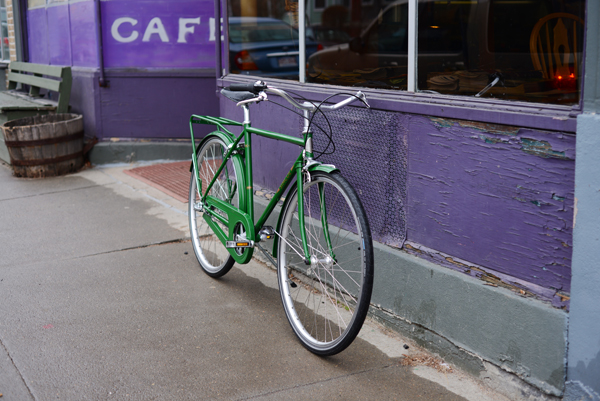
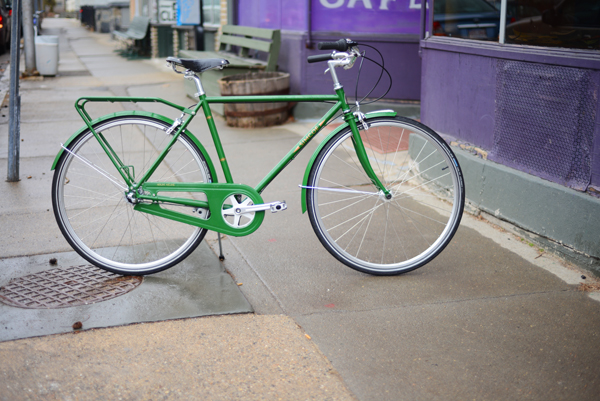
Getting back to the bicycle itself, the Simcoe Roadster is a fairly straightforward English 3-speed inspired city bike. Relaxed angles, upright position, hub gearing, fenders, chaincase, rear rack, kickstand. Front and rear caliper brakes. The Roadster bikes are available in 20" and 22" frame sizes, both with 700C wheels and 35mm Delta Cruiser tires. The weight is not stated, but I would estimate it to be between 30 and 35lb.
Simcoe Roadster
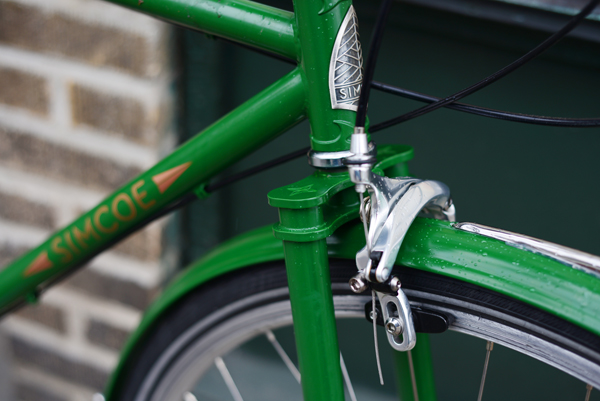
The Taiwan-made frames (described as combination hi-ten steel and cromoly) are welded, with a couple of faux-lug flourishes on the headtube. 

Simcoe Roadster
The cromoly fork features a nice twin plated crown with a 4-cornered star emblem. 

Simcoe Roadster
The headbadge is a sort of stylised leaf. I could be reading too much into this, but maybe an homage to its Canadian provenance? The word Simcoe itself - which at first I thought might be a combination of the founders' initials followed by "Co" as in "company," is in fact the name of a town in Ontario. 
Simcoe Roadster
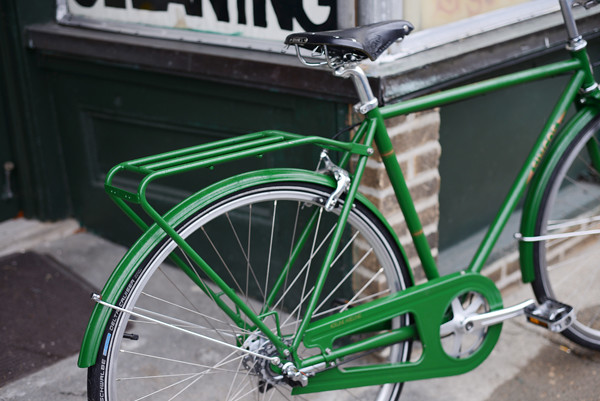
The Roadster's chaincase is one-sided and open at the rear. While not fully enclosed, it allows for easier wheel removal and still keeps most of the chain covered. The rear rack is extra long,

Simcoe Roadster
with built-in bungee cord attachment points.

Simcoe Roadster
Eyelets at the fork dropouts allow for an optional front rack as well. 
Simcoe Roadster
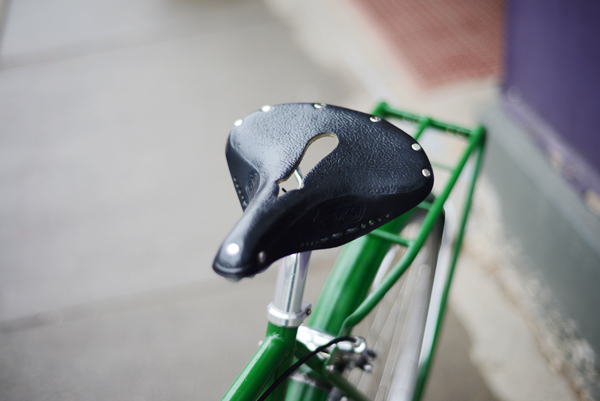
A Brooks B68 saddle comes standard with this bike. The cost for the 3-speed Signature Roadster model as shown is $899. At that price it comes fully equipped for utility cycling, with the notable exception of lighting. 

Simcoe Roadster
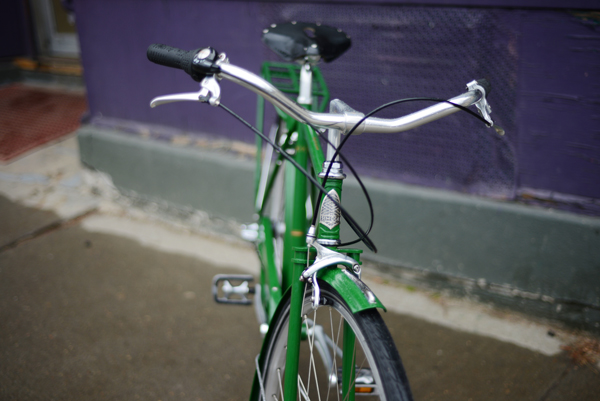
As far as the Simcoe Roadster's looks, I am neutral. Abstracting my dislike of this almost neon shade of kelly green (it's also available in blue and slate gray), the bike comes across to me as rather ordinary, perhaps even made a little awkward by the extra-long rear rack. Were I to see it in a line-up next to a Linus, Papillionnaire, and the like, I don't think it would stand out as a "nicer" bike, despite the stock Brooks saddle. Yet it is priced a step above these. To me, the price difference would be worth it for the feel and ride quality of the Simcoe. But I wonder whether the lack of aesthetic differentiation might be an issue for potential customers. 
Simcoe Roadster
If you are considering Simcoe's Step-Through model, please note that I did not ride that version of the bike. Judging by the pictures, the step-throughs are constructed differently from the diamond frames. I am curious to try one and perhaps some day I will, but for now my feedback applies only to the Roadster. 

For a company brand new to bicycle manufacturing, the Simcoe Roadster is an impressive start. As distributors, the guys behind it have had a great deal of experience with both European city bikes and North American customers, and it shows. And it probably didn't hurt that one of the designers learned frame building from Mike Flanigan. If you're in the market for a sub-$1,000 city bike and are chasing that intangible "vintage bike feel" in a modern machine, the Simcoe Signature Roadster is worth a look - but more so, a test ride. 

Non-Holiday Romance… Fumblings with Budnitz No.5


0 comments
Budnitz Model No. 5
To a monolingual English speaker’s ear the name Budnitz might not evoke any particular associations, other than a vague sense of Eastern European linguistic origin. But to an ear attuned to tongues from said region, the association is an interesting one. The name is formed around a word that might be translated as “weekday,” or “non-holiday.” In Russian, for instance, a budni den is an ordinary day, a workday. And while budnitz is not an actual word in any language I know of, if it was it would mean something like “weekdayer.”

What to expect from a bicycle thus named? While so many manufacturers market cycling around a fantasy of carefree joyrides, here is one that – whether deliberately or not (after all, Budnitz is simply the owner’s surname; he might not be aware of its roots) – insists upon the reality of ordinary, everyday life. This filled me with great expectations. Expectations of supreme utility, comfort and durability. But also of a certain special something that would make transportation cycling feel so wonderful, so effortless, so pleasurable and fun, that the weekday would become the new weekend. Would I see anything of the sort in the bike I had been invited to test ride?

Budnitz Model No. 5
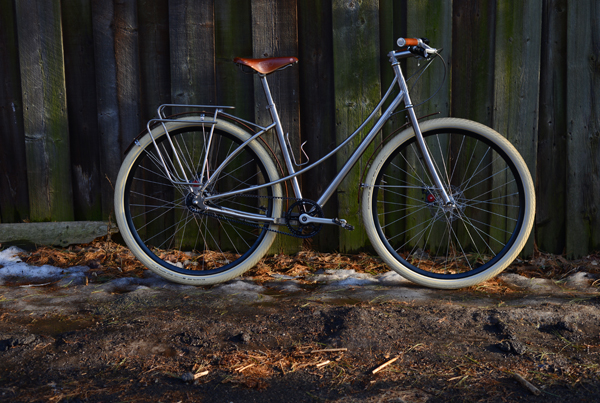
When I opened the door that wintry March morning, what I saw was almost too much to take in: a titanium swoopy mixte with fat tires, belt drive, disc brakes and wooden fenders. It was their new model, the No.5 – described as “the ideal step-through framed bicycle [defined by] elegance, grace, and speed.” Well, they got the elegance part, I thought, picking up my jaw from the ice-encrusted pavement.

The beauty of the Budnitz No.5 was doubly surprising, considering that (1) I don’t like the looks of any of their other models, and (2) it is tremendously challenging to build a mixte out of titanium tubing and with modern components that looks cohesive and elegant. But I have to hand it to Budnitz - they did it. The bicycle in front of me looked stunningly gorgeous to my eye. It was also full of interesting features.

Budnitz Model No. 5
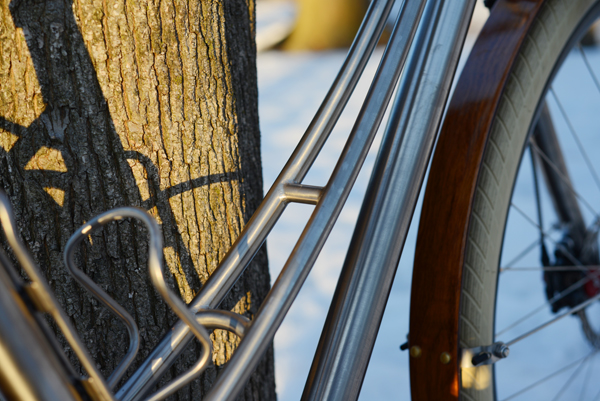
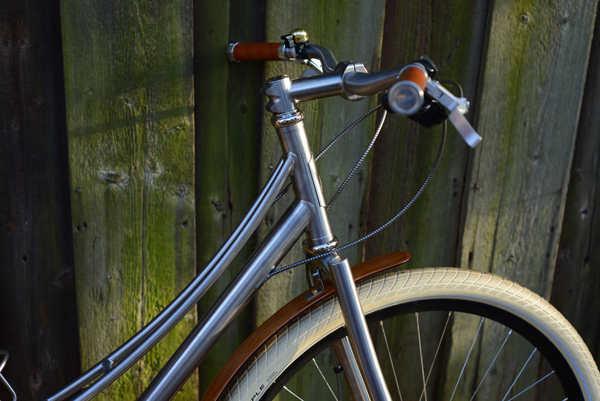
Not only was the curvy, twin lateral stay frame titanium,

Budnitz Model No. 5
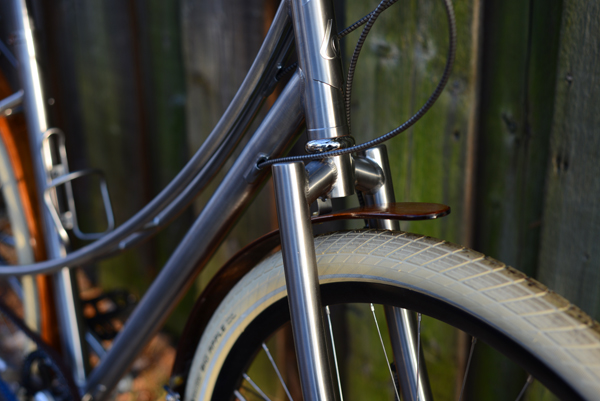
but so was the segmented fork. Most titanium frame builders do not offer matching Ti forks (you get a choice of carbon or steel instead), feeling it is cost-prohibitive to make them in such a way that they are neither too flexy nor overbuilt. So the Budnitz titanium fork is quite a rare beast.

Budnitz Model No. 5
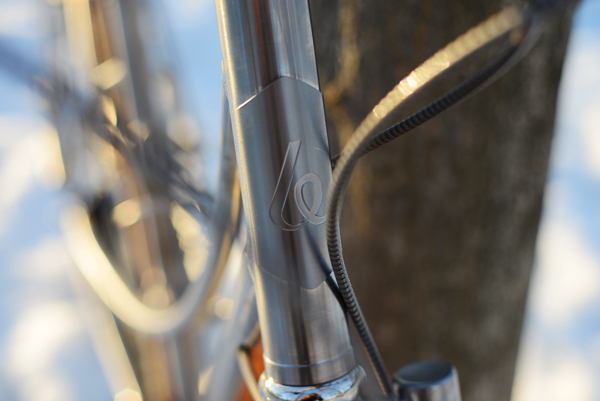
Also titanium are the stem, handlebars, headset, and seat post. All of these are proprietary, marked with the Budnitz name.

Budnitz Model No. 5
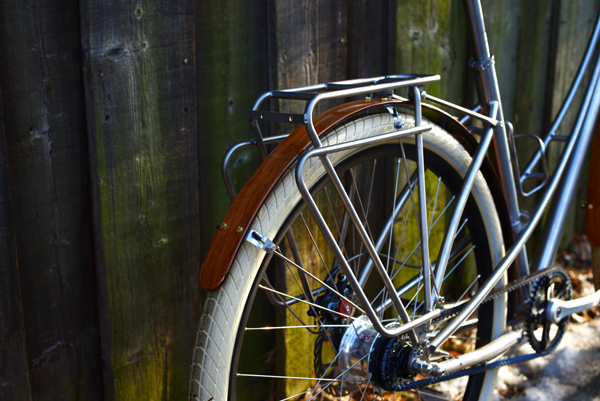
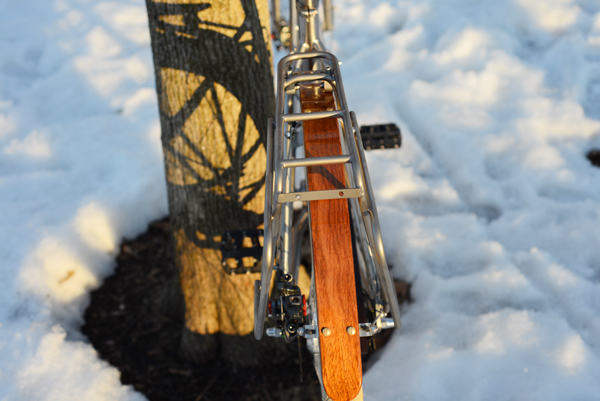
Finally, the elaborate Tubus rear rack is titanium as well -

Budnitz Model No. 5
affixed slightly off center to accommodate the disc brake on the rear wheel.

Budnitz Model No. 5
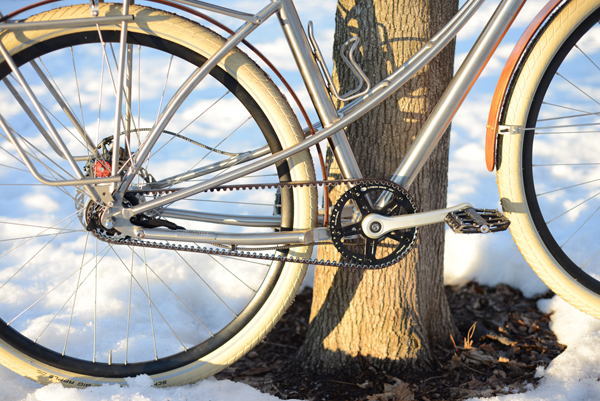
The other notable feature is the Gates belt drive, which came with a DaVinci crankset and an Alfine 11-speed hub. 

Budnitz Model No. 5
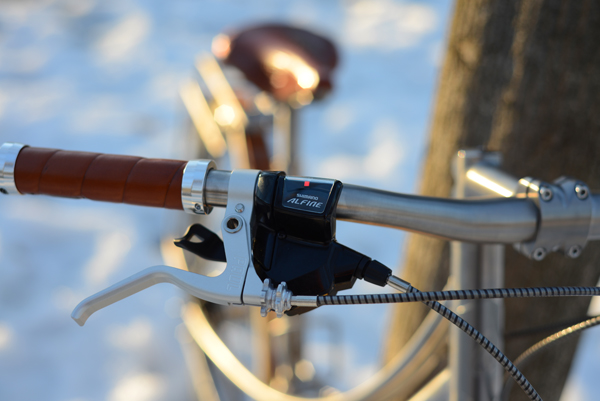
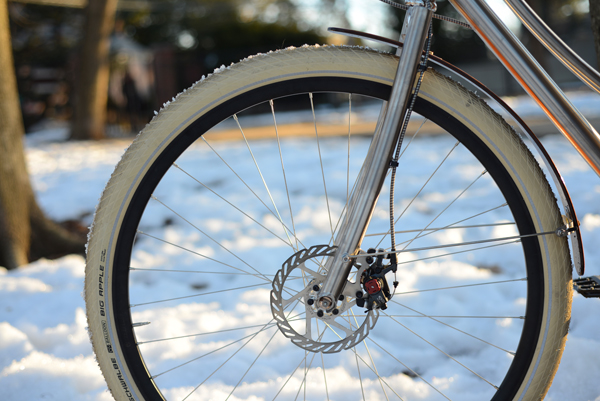
Paul brake levers activate the front and rear mechanical disc brakes.

Budnitz Model No. 5
The cable routing for the brakes and shifters is quite elegant, routed along the left fork blade for the front brake, then internally for the rear brake and shifter.

Budnitz Model No. 5
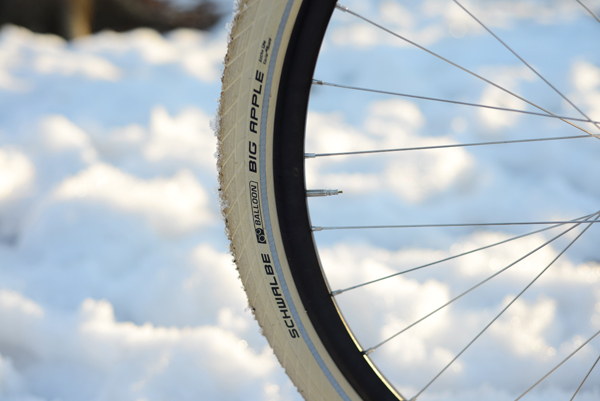
The Budnitz No.5 is a commuter bicycle based on a 29er mountain bike design. The (700C equivalent) black-rimmed wheels sport fat Schwalbe Big Apple tires in cream.

Budnitz Model No. 5
The lacquered wooden fenders are a nice match for the caramel Brooks saddle and leather grips. The warm brown of these accessories complements nicely the unpainted matte titanium frame, silver and black components, and cream tires. Overall the bicycle looks impressively clean and neatly put together, despite the heady mix of components and accessories. 

When a certain other blogger reviewed a Budnitz bike a couple of years back, I recall he complained of shoddy assembly. In fairness to Budnitz, I should note there was none of that with my test bike. Over the 2 week period this mixte was in my possession, everything functioned smoothly and silently - they did an excellent job. 

Budnitz Model No. 5
So what we have here is an all-titanium transportation bike with a low standover, fat tires, strong brakes, low-maintenance (allegedly) belt drive, a gazillion of high-end modern features - and it's beautiful to boot. What's not to love? 

Well, for one thing, there is the weight. For a bike with such an impressive mix of titanium and other nice components, I found it to be remarkably heavy (over 30lb, I would estimate). While this figure is very reasonable for a store-bought city bike, considering the cost of the Budnitz (over $5,000 for the build as shown) and the care taken to source lightweight parts, I would expect it to be much, much lighter. For comparison, my personal steel mixte, outfitted with 650Bx42mm tires and mostly midrange aluminium components, weighs noticeably less - and that's including dynamo hub, lights, big front rack, and kickstand - all of which the Budnitz lacks.

Neither did I find the No.5 especially fast compared to ordinary upright city bikes. It is a comfortable bicycle for certain, the combination of titanium and those fat Big Apples ensuring a wonderfully cushy ride quality. But I would not say speed or maneuverability are its strong points. The combination of the big wheels and fat tires felt clumsy - a bit like riding a monster truck. And when pedaling, I just couldn't seem to get into that groove where I'd feel a direct translation of my pedaling efforts into the bicycle's forward movement. Cycling up hills was a particularly tedious ordeal, no matter what gear I switched to on the 11-speed hub. Again, I do not mean to suggest that the Budnitz was unusually slow for a city bike. But it didn't have the kind of light, sporty feel that I would expect from its price tag, description and materials used. 

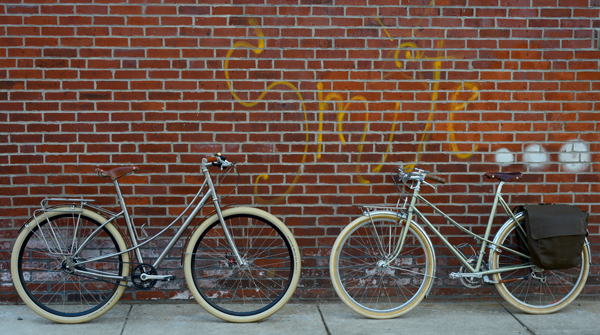
Budnitz No.5 vs My Swoopy Mixte
Finally - and, granted, this part is the most subjective - I could not get comfortable with the fit of the Budnitz. Despite the mixte frame design and mountain bike inspired geometry, it fits almost like a Dutch bike. The Medium sized frame, described as appropriate for my height, felt simultaneously too big and too small - the headtube extended so high, it was impossible to get the handlebars as low as I wanted them, yet the virtual top tube on the shorter side of what I would normally ride. Going down a size would be much too cramped, and the larger size would be even more upright. The high bottom bracket is also something I don't care for on a transportation bike. You can see how much higher off the ground I need to be on the Budnitz compared to my own bicycle to achieve decent leg extension. And then, there is the toe overlap - which is considerable and impossible to ignore; I would hit the tire with my toe every time I'd try to make a U-turn. To each their own, but the fit and geometry of this bicycle did not suit me. I should note, however, that switching to 650B or 26" wheels could solve most of these issues - has Budnitz considered it, I wonder? 

Budnitz No.5 Test Rides
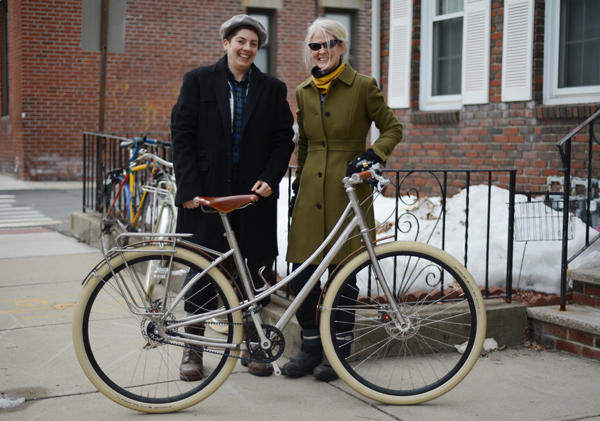
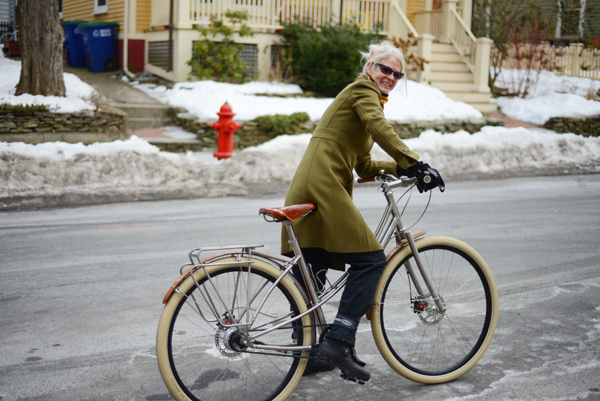
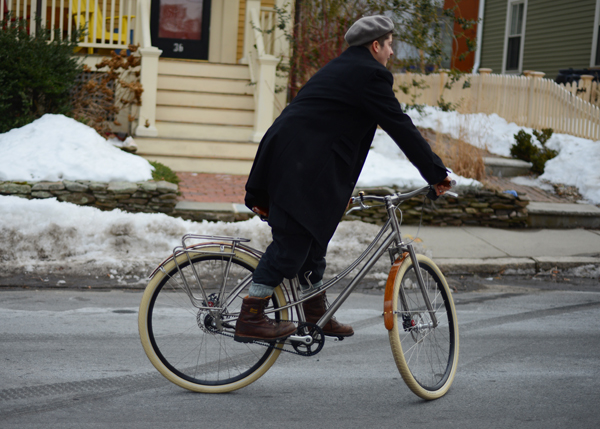
Given how much I liked the look of the Budnitz, and the idea of a fully equipped titanium transportation bike in general, I felt badly about my less than enthusiastic response after test riding it. So I asked a few friends to take it out for a spin as well. A total of 4 others rode it, including Emily and Pamela pictured above. The other test riders were less critical of the speed than I was (although their test rides were much briefer than mine). But all of them commented on how surprisingly heavy the Budnitz was, as well as on the dramatic toe overlap.

Budnitz No.5 Test Rides
Pamela also noticed that her foot would hit the bottle cage (mounted on the seat tube) when she'd step through the frame - something that I had experienced as well, but forgot to mention. In fairness, with step through and mixte bicycles the decision of where to mount the bottle cage is tricky. Put it on the downtube, and it can be too low for comfort. On the seat tube and you can kick it when stepping over. 

Budnitz No.5 Test Rides
And one thing Emily pointed out, was that the Budnitz was more difficult to track-stand - in particular no hands - than other bicycles she's ridden. Buyer, beware!

Budnitz Model No. 5
Jokes aside, I've tried to share my impressions of this bicycle fairly. When people discuss Budnitz Bikes, the issue of price point tends to be hotly debated. In theory I do not have a problem with a $5,000 titanium transportation bicycle. Manufacturing costs for small-batch projects are high and titanium as a material is expensive; this price tag - or higher - is pretty much to be expected. To manufacture their bikes, Budnitz (a Vermont-based company) works with a Taiwanese framebuilder who specialises in titanium, and is particularly equipped to bend Ti tubes according to their specs. The complete bicycles are then assembled in Vermont and sold to customers directly. I like the idea of a well thought through, made-to-last titanium bike for transportation, and I've reviewed a couple of others in the past (see here for instance). The Budnitz No. 5 is a beautiful bicycle, but, in its current iteration, not my cup of tea. 

It's a Beater


0 comments
In cyclist jargon, to refer to a bike as a "beater" is to describe a machine that is so weathered, so cheap, so ugly - or, ideally, so all three of these things - that you do not care about wrecking it. Sure you might have your nice bike. But it's the beater you leave out in the rain for days, ride on heavily salted roads,  lock up outside bars in dodgy neighbourhoods, and generally subject to all manner of abuse. Because who cares - it's a beater. On this concept a Canadian company has based an entire line of city bicycles, named …drumroll… Beater Bikes. For $350 a pop you get a single speed roadster, either diamond frame or step-through, equipped with a surprising amount of commuter accessories.

But what sort of creature is this Beater, with its hammer-head tulip headbadge and krylonesque paint job? The Bicycle Belle in Boston carried them briefly, which gave me a chance to try one. And you know what? By golly, I liked it. The Beater is not without faults, but as far as "budget bikes" go, it seems hard to beat (heh) and has now replaced the KHS Green as my favourite bike of that category.

As far as the basics, the welded frames and forks (described as simply "steel") come in one size only (53cm for the diamond frame and 45cm for the step-through) and one colour - matte racing green. The loop design of the step-through is attractive, in a subdued industrial sort of way, with nice even curvature, clean welds and a unicrown fork that blends in well with the frame. Aesthetically, the bike looks simultaneously classic and modern, with a subtle dystopian undercurrent to it. The all-black components (rims, crankset, stem, seat post, handlebars) complement the matte green frame finish and, combined with the iconography of the headbadge, give off a futuristic and vaguely sinister vibe. Not in a bad way. It's an interesting juxtaposition, with the bike being so vintagey in concept. Loop frames can come across as too cutesy, but the Beater does not suffer from that. The complete bike weighs under 30lb, which is pretty good for an all-equipped city commuter of this style. In addition to the single speed, a 3-speed version is available for an extra $100.

On the step-through model, the headtube is extended past the seat tube considerably, and the stem is extra long to allow for a super-upright posture. For someone of my height (just under 5'7") or taller it is also possible to adjust the fit so that handlebars and saddle are level, for a sportier position.

I like the proportions of this bicycle. It is compact compared to a genuine Dutch bike, but the "cockpit" does not feel cramped. And as far as the Beater's ride, I thought it a very normal-feeling, unremarkable (in a good way), stable bike that beginners would feel comfortable on, but experienced cyclists would not find limiting - as long as they don't expect performance beyond the city-bike category. The ride quality is not as plush as that of some others I've ridden, but it's not harsh and is better than I would expect at this price point. The bottom bracket is not too high, so it is possible to put a toe down at a stop while remaining in the saddle and still get decent leg extension when pedaling. And for me there is no toe overlap despite the 700C wheels with 38mm tires and fenders.

In addition to the fenders and chainguard, which are colour-matched to the frame,

the Beater comes equipped with a rear rack,

a double-kickstand,

battery operated LED headlight and tail light, a bell, padded vinyl saddle, rubber grips, platform pedals and even a front wheel stabiliser.

What it doesn't come with is a front brake. And therein lies the Beater's tragic flaw: It is coaster brake only. Now, I like coaster brakes as much as the next contrarian, euro-born, skirt-wearing, baguette-toting transport cyclist, and am prepared to debate their merits in my sleep. But even I would not make a bike that's meant to be ridden in North American cities coaster-brake only. I mean, come on, Beater - a pile of accessories but no front brake?.. Anyway. The proprietress of the Bicycle Belle was of the same opinion, which is why she retrofitted her entire stock of Beaters with front calipers before allowing them out the door. The good news is that this can be done aftermarket. The less good news is that it increases the bicycle's cost, thereby diminishing the wow factor of what would otherwise be a perfectly decent and ridable, fully commuter-ready $350 bike.

So, if I might be so bold as to make a suggestion to Beater: Why not nix the front wheel stabiliser (the cheap ones are no-good anyway) and replace the double kickstand with a plain old single one, then use the savings to fit the bikes with front brakes? (And to be honest, if catering to the North American market, a bike with front and rear hand-activated brakes in lieu of coaster would sell better still - but I am not versed on the cost difference that sort of change would entail.)

All things considered, I enjoyed riding the Beater. For the price point, I am impressed with both its design and with the accessories package it comes with. How well will a bike like this hold up in use is a question only an owner can answer - and if you are one of them please feel free to share your experience. Based on my limited impressions, I would recommend the Beater to readers searching for an off-the-shelf city bike for under $500 ...if it weren't for the manufacturer's choice of brake system.
older post