Showing posts with label comfort. Show all posts

The Cycling Swell


0 comments
“Why is it I feel so disgusting after cycling? And just look at these, how swollen they are!”

Putting down her emptied water bottle, the woman sticks out her wrists to demonstrate. The flesh is puffy above her gloves, folding over muffin-top style. Mine look similar, as do my ankles over the edges of my socks. For a few minutes the group of us sits there, comparing unattractively swollen body parts.

There is an expectation that cycling will make us sleek and lean, instantaneously. But, in particular when riding long distances, many are alarmed to find themselves bloated and swollen instead. The first time it happened to me in a noticeable way, I went on the internet and found a dazzling array of explanations. It happens from not drinking enough water. It happens from drinking too much water. It happens from overconsumption of calories from energy drinks and snacks. It happens from consuming too few calories. It happens if you eat too many carbs or not enough carbs. It may or may nor happen more if you are a woman. It is due to water retention and will lead to temporary weight gain, followed by weight loss. It is due to cortisol production and will lead to real weight gain, accompanied by other problems. "There is no cause for concern," said the highly qualified doctor of Cyclist A on Forum X when consulted about the symptoms. "There is cause for concern, and you must cut down on cycling," said the equally qualified doctor of Cyclist B on Forum Y. Well then, there's that explained!

Monitoring myself over the past few years on the bike, I see two types of processes at work. One is the temporary bloating I get in the course of a single ride. This tends to happen on rides longer than, say, 50 miles. And it seems absolutely unrelated to the amount of water or calories I consume. Either way, I will get a little puffy, a little bloated - noticeable mainly in the face, ankles and wrists. And, a few hours after the ride is over, it will all go away. The swelling will diminish, then disappear; my skin's tautness will return.

The other is a longer-term process that seems to happen when I do a lot of cycling all at once following a period of taking it easy. After a couple of weeks of doing the miles in earnest the first thing I notice is that my legs get big - so big that I have trouble getting my jeans on. The first year this happened I mistook it for very rapid muscle development. But now I know it is a temporary effect - more like a swelling from the shock of those muscle groups being overworked. In the first instance, my legs bulge out. But if I keep cycling at the same frequency and intensity, their size will eventually diminish. Gradually the swelling will subside and give way to actual muscle tone - hard, sleek and well defined, rather than puffy or bulging. And my jeans will fit again. Last summer this happened over a 2 months period.

Very possibly there is more than one single cause behind the cycling swell. But in any case, it is apparently not unusual. This spring I've just entered the "can't get my jeans on stage" and look forward to getting it over with!

Cycling Bibs for Women: 4 Basic Styles


0 comments
Lately I've been getting lots of questions about women's bib shorts. Are they more comfortable than regular cycling shorts and worth switching to? Having made the switch to bibs a year ago, for me the answer was Yes. As soon as I tried bib shorts it was love at first ride. Instead of an elastic cutting across my belly fat and chafing my skin on long rides, bibs offered a wonderful feel of support and compression. True, the under-the-jersey straps make peeing a more elaborate process for women. But that is a price I am willing to pay for the extra comfort I get out of them on the bike.

So the next question is, which style to chose? There seem to be so many. The funny thing about that is that until recently there were almost none. Cycling shorts and tights would be offered in a bib style for men, but not women. Then a couple of years ago this suddenly started to change, with manufacturers scrambling to come up with women-specific designs and each seeming to arrive at something different. But why the need of a women's specific style in the first place? Let's start by examining the traditional design.

The Classic Bib Design

Unlike elastic-waisted shorts, cycling bibs stay up via suspender-style straps. These straps can be either solid of mesh, narrow or wide, and they can vary in their degree of stretch. The classic cycling bib design (ie most men's bibs) routes the straps straight up and over the shoulders, as shown on the left. For women this can be problematic, as it means the straps are placed directly over the breasts. Depending on the size, shape and orientation of the breasts and nipples, this can result in uncomfortable digging into sensitive tissue - in particular with straps that are on the narrower side and made of a dense, not super-stretchy fabric. Because there is so much variety in this part of a woman's anatomy, it is difficult to come up with bib dimensions that will solve this problem - which is why most manufacturers avoided the issue altogether and stuck with ordinary shorts for their women's lines. Still there there are manufacturers who produce women's bibs in the classic design - for instance, Road Holland. I own a pair of these and find them comfortable enough. The straps are very wide and made of a lightweight, stretchy mesh; worn over a sports bra I can hardly feel them. But again, reactions to this style will differ depending on the specifics of the design and on your anatomy. In particular, women with large breasts and large, sensitive nipples may find the routing of the straps uncomfortable.


The Open Bib Design

Some manufacturers have tried to address the problem of bib strap routing by making them "open" - that is, routed around rather than directly over the breasts. Here the straps sit at the far sides of the torso, close to the armpits, resembling the back of an athletic swimsuit. Personally, I find this style the most comfortable out of the ones available. The bib straps on my Giordana shorts keep clear of my boobs and stay in place remarkably well; I cannot feel them at all when on the bike. However, I know that some women dislike having the straps so close to the armpits and experience chafing at the inner arms. This does not happen to me at all. But whether this style works for you will depend on your anatomy and skin sensitivity.

The Y-Front Bib Design

An alternative style of routing bib straps to avoid the breasts is the Y-front. Here the straps meet at the collarbone and connect to form a single panel that sits between the breasts, then gradually expands at the abdomen to merge with the lower part of the shorts. Assos, with their coy models, is particularly well known for this style and I have a pair of their shorts for review. The Y-strap bib routing is clever and feels comfortable enough to me - with the caveat that the size has to be spot on, or else the strap will either choke or feel too loose. Some versions of this style also feature a clasp - presumably for easier removal of the straps in order to pee. Personally I do not like having a clasp at my sternum and would prefer the version without it. All in all, the y-front style is a little too fussy for me - but preferences will differ.  Those with unusually long or short torsos might have trouble finding a good fit.

The Full-Coverage Bib Design

Yet another way to avoid dealing with boobage issues is with a full coverage style of bibs. Similar to a bathing costume circa the 1920s, this design is basically a combination of shorts and a tank-top. Typically a zipper will run down the middle. Rapha makes their women's bibs in this style and I own a pair of the 3/4 knicker version. In some ways I like this design, in particular I enjoy the extra compression that comes with the full coverage. However there are times when I just don't want all that extra fabric around my torso - when I'd like to wear bibs and not a full body suit. Aside from this, women with large breasts and narrow hips or vise-versa might find it tricky to get a good fit, as the top and bottom proportions are either/or.

There are other women's cycling bib designs out there, but I find that most are variations on these four. Every season it seems there are more and more manufacturers offering various versions of women's cycling bibs. If you are looking to compare styles and prices, Team Estrogen looks like a good starting point. If you have your own favourite style, brand or model, please share what works for you - as well as what doesn't. Women in all shapes and sizes can and do wear bib shorts. But they are not for everyone; in the end it is all about what suits you personally.

Cycling and Headaches


0 comments
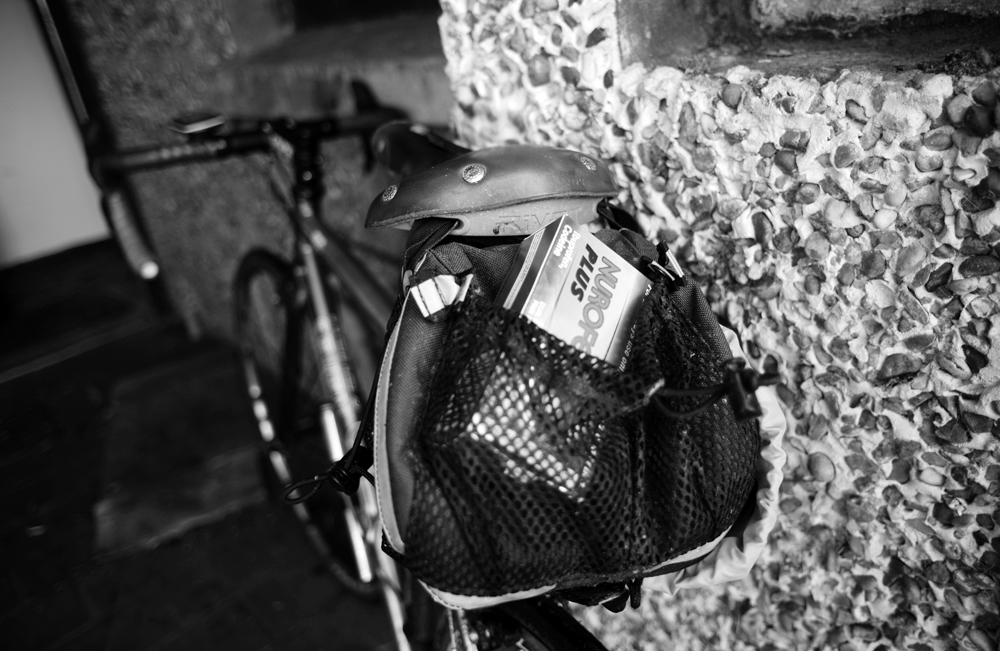
Being prone to migraines and tension headaches, I make sure to carry pain meds as part of the standard dayride kit in my cycling bag. But I've never actually had to use them to treat a headache. In fact, I cannot remember ever having a headache on the bike. This realisation came to me a couple of nights ago, when a quiet evening of movie-watching at a friend's house ended in a brain-piercing, want-to-bang-head-against-wall type of headache the likes of which I haven't experienced in some time. It felt mild enough to ignore at first, and after a trip to the kitchen for a glass of water I settled back on the sofa amidst the other lounging bodies in the darkened living room. But when the film was over and the lights came on, the real pain began. Behind the left eye. Throbbing. Spreading with a slow horrible pressure toward the back of my head. I was getting a lift home in a friend's car, a 25 minute drive. In the course of those minutes things went from bad to worse, and I'm pretty sure that my face came to resemble Munch's The Scream in its grotesque contortions. Even after I got home and took a hefty dose of headache medication, it took an hour of lying perfectly still in a dark room for the storm in my head to calm. But it was while writhing in the passenger's seat with the window rolled down that it hit me: I have countless memories of being stuck in a car with debilitating headaches - but none of having a headache on a bike.

Certainly all the ingredients have been there. Long, windblown hours under direct sun. Physical exhaustion and dehydration. Hasty departures without morning coffee. Tightly adjusted helmets. Tail lights of cyclists in front of me shining directly into my eye on group rides. And yet it has never happened. I've had headaches after bike rides and before bike rides, just never during. And I've had headaches during other forms of exercise - namely running (well, attempting to run). Could there be something special about cycling that prevents them?

According to a neurologist friend, that is not impossible. The research on headaches and exercise is mixed. In some instances exercise can actually induce headaches ("exertional headaches"), and there appears to be a higher risk of this with high-impact exercise and weight lifting. In other instances, exercise can be used therapeutically to treat headaches, including migraines. These would be exercises that are low impact and promote relaxation and tension-reducing posture alignment. Yoga is probably the most typical. But it is plausible that cycling could play that role as well - depending on how it makes us feel and how our body is positioned on the bike. And I suppose all that fresh air couldn't hurt either.

Whatever the reason for it, I am thankful to be headache-free when I pedal. I will continue to carry pain meds on rides, just in case. And I hope to continue not needing them.
older post