Transportation Cycling in Rural Areas: Some Food for Thought


0 comments
The present-day culture of transportation cycling is predominantly associated with urban living. This makes sense, considering the realities of life in cities and their immediate vicinities. When commuting distances are short, motor vehicle traffic horrendous, and public transportation either overcrowded, unreliable or both, riding a bike can become an attractive option for getting around. Throw in some cycling infrastructure and perhaps a bike share system, as many cities are currently doing, and the appeal becomes greater still – especially as rising numbers of others take to the streets on two wheels, making it seem increasingly more normal and realistic.

But the desire to cycle for transportation is not limited to urbanophiles. Some rural residents may be commuting by bike already. Others may be considering it. Others still may be cyclists who currently live in a city, but are contemplating a move to the countryside. For the latter two groups a slew of questions and concerns might arise, with not a whole lot of resources out there to address them. This has become especially apparent to me since my own move to the countryside some months ago - in the course of which my email inbox has filled with questions from a surprising number of would-be rural bicycle commuters. Now that I’m feeling a bit more settled, I would like to start sharing some thoughts on the topic.

To state the obvious, there is a great deal of regional variation between rural areas. Differences in climate, terrain, distances and the availability of safe cycling routes will play a huge role in how realistic commuting by bike will be. Perhaps less obvious is that these differences can exist even within the same locale: pockets dense in amenities and pockets that are not, pockets that are hilly and pockets that are flat, pockets that offer safe routes for cycling and pockets that do not. As an example: My current house, while situated in what is generally a remote and shockingly hilly part of Northern Ireland, happens to be in a pocket that is unusually convenient and bicycle-friendly. I am just over a mile from a sort of farming hub, with several small shops selling basic provisions and local produce, and 7 bike-friendly miles from the nearest small town. Being at the base of a mountain but not on it, I have easy access to flat routes and enjoy mostly ice-free roads in winter due to warmer temperatures than neighbours who are even slightly uphill. In a pinch, I am also only a mile from a bus stop and two miles from a train station. Other parts of this very same region are far less handy for getting around by bike. This is all to say that it is essential to get to know an area thoroughly before forming an impression of what commuting by bike will be like there. Even to assume regional homogeneity would be a mistake. 

But speaking more generally, rural transportation cycling, as I see it, is not just about locations, distances and terrain. It is a categorically different kettle of fish from urban cycling. Why? Because it is fueled by a different set of motivations. Whereas in the city, cycling might be the faster, more convenient transportation option, in the countryside that is extremely unlikely to be the case. With long miles to cover, little in the way of traffic congestion and parking easy to come by, the car is clearly the more convenient choice here. So in devising ways to commute by bike in rural areas, we are doing so because we value cycling in of itself more than we value convenience. For some, this could boil down to physical fitness. Commuting by bike make take longer, but it is in fact two activities in one - commuting and keeping fit, saving time that would otherwise be spent at the gym. For others the real issue is financial. The bike costs next to nothing to run compared to the costs of a car, and for that some loss in convenience could be seen as worth it (or simply, necessary). There could be other underlying factors. Environmentalism. Or the inability, be it for legal or physical reasons, to operate a motor vehicle. But all that considered, I would venture to say - and this is just a guess really, a hunch, an intuition - that for a great portion of dedicated rural bicycle commuters in the developed world, the love of cycling for its own sake is the dominant motivating factor. It may be an irrational love. A love that goes against what's reasonable or practical. But it's a love strong enough to, however creatively, turn it into reality. Otherwise, it is just too easy to opt for other forms of transportation. And people generally do what's easy, unless they love the other option that much more. 

In the coming months, I hope to continue sharing thoughts and ideas on different aspects of rural transportation cycling. I would also like to compile a list of rural cycling blogs and post it here. My collection of links to those is pretty small so far, so if you know of any - or write one yourself - please do share!

Two Wheel Affinity


0 comments
As a cyclist I've never felt much of a connection to motorbikes. Yes, they have two wheels, they lack an enclosure, and they are kinda sorta bike shaped. But so much of the cycling experience is about pedal power, which is not part of the motorbike experience. They are motor vehicles. For me, this put them in a category closer to cars than bicycles.

It's been interesting to learn that in Northern Ireland many see it differently. There is a lot of overlap here between cyclists and motorcyclists, both in racing and in recreational riding cultures. One friend did short circuit motorbike racing in parallel to bicycle road racing through the '80s and '90s. Several others spent their youth involved in motocross or trials. Others collect vintage motorcycles along with vintage bikes. And others simply enjoy riding motorcycles for pleasure or touring much like they enjoy these activities on a bicycle. To explain the connection, they describe the similarities: The feel of being out in the elements, the handling skills, the sensation of wind on one's face. It's similar, with enough of a difference to make switching back and forth interesting in its own right. "You should try it!" Oh of course, ha ha.

Two big-deal motorcycle races are held on the open roads of Northern Ireland: the North West 200 and the Ulster Grand Prix. Unwittingly I became a spectator of the former when I visited in Spring 2012. The course passed nearby and one day I sat on the grass watching the machines fly past at incredible speeds (top speeds of over 200mph, I later learned). Even for someone with no interest in the sport, it was an exciting thing to see. The following summer I was staying with friends and they watched the Ulster Grand Prix on television. This was around the time I was starting to get a feel for cornering and other bicycle handling skills. And watching the racers go around the bends of roads that looked just like the roads I cycled on - leaning their motorbikes this way and that at dramatic angles - I grew absolutely absorbed in their movements and could almost feel the road from their perspective. For the first time, I felt the connection.

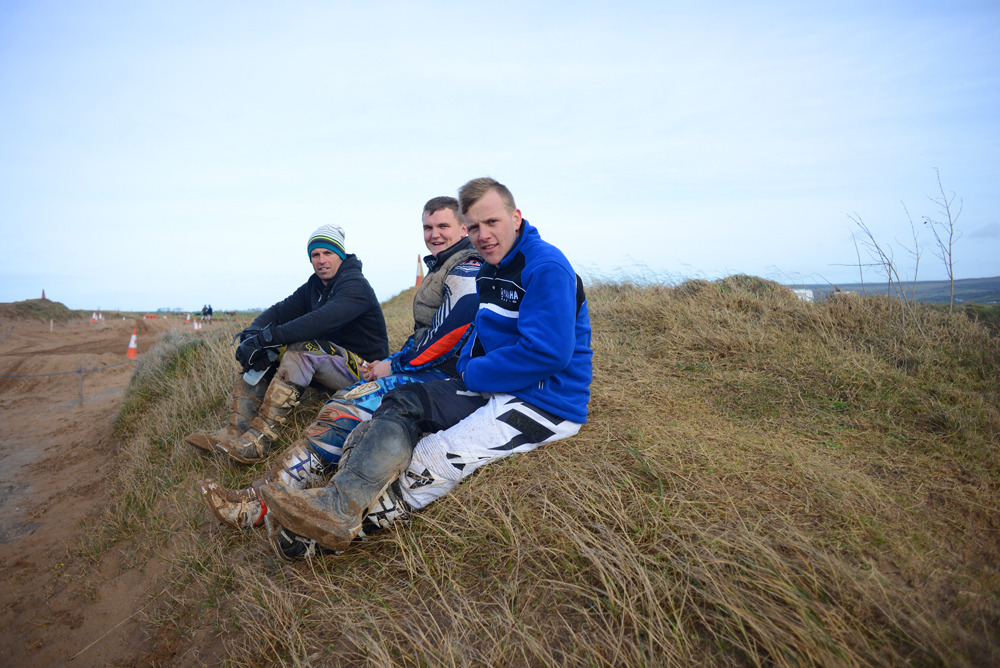
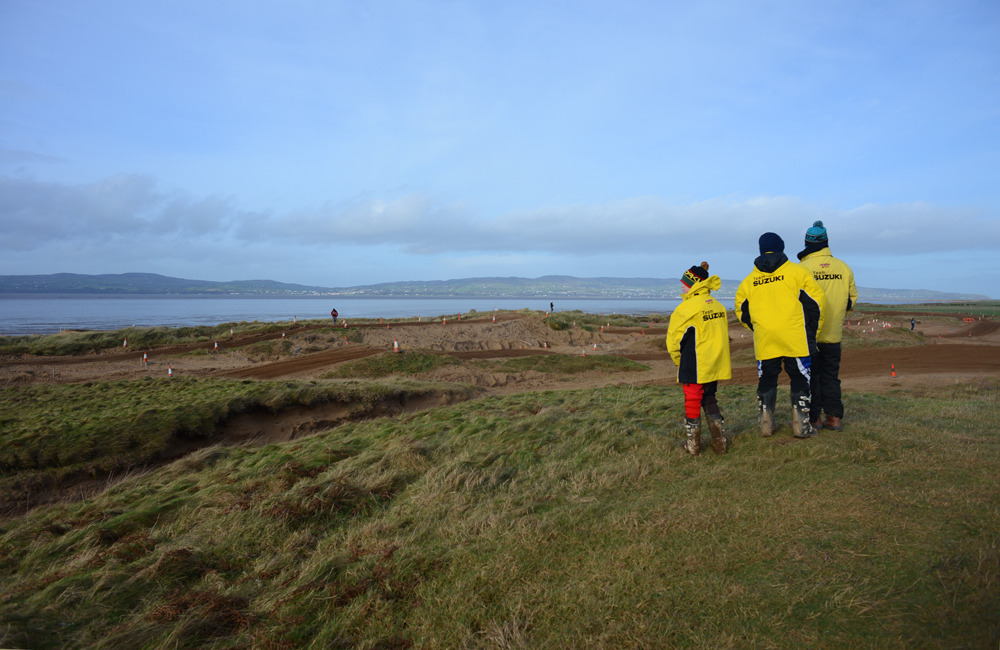
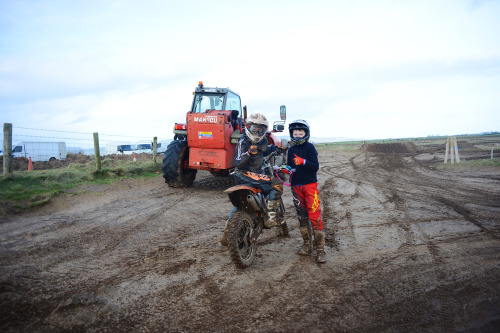
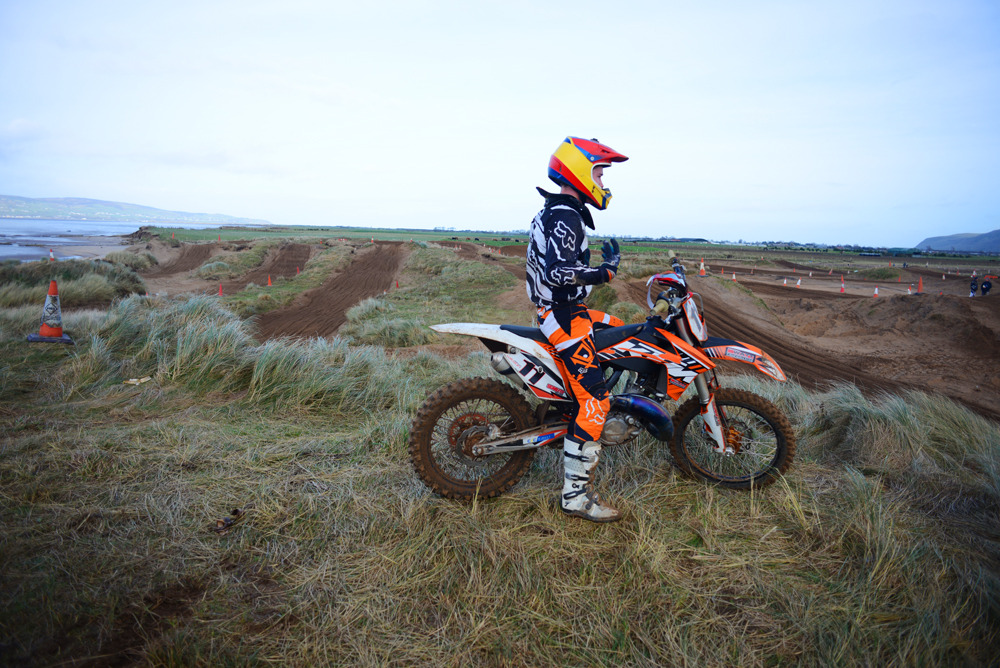
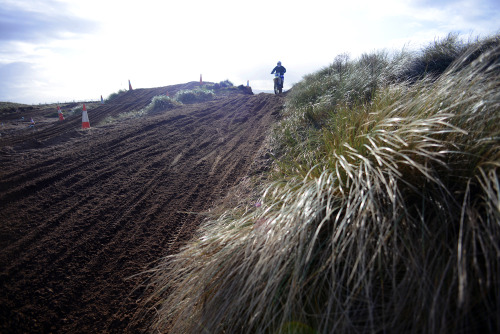
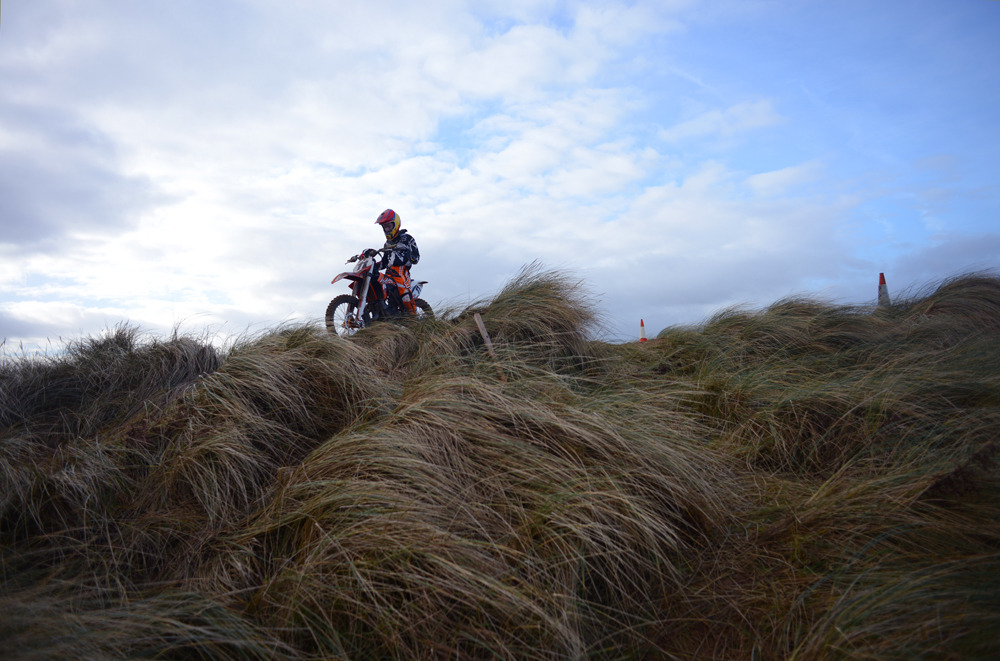
From the fields behind my house, I can sometimes hear a distant buzzing sound. I know there's a motocross practice track somewhere there and plan to have a look one of these days. When I finally do, the Magilligan Motocross Track is grander and more beautiful than anything I expected. An expanse of tall sand dunes on the shore of Lough Foyle, topped with windswept silver-green grass. With a crazed buzz and violent sprays of soil, dirt bikes race through these hilly muddy sandy loops, whirlwinds of colour. The impression is that of a naturally occurring landscape that happens to be perfect for their mad purpose.

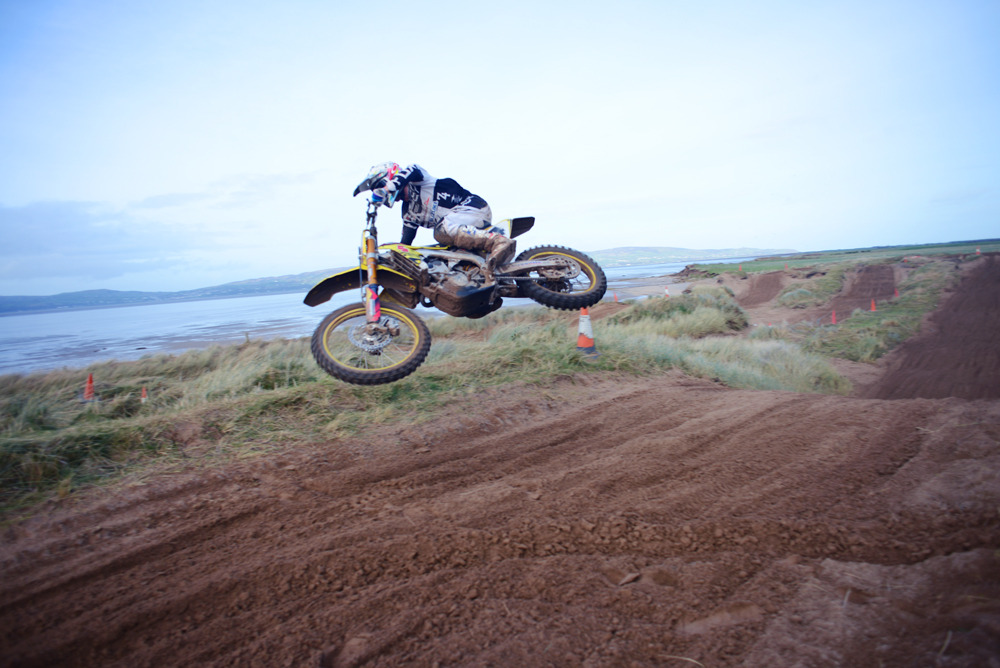
Seen up close they are viscerally stunning. It is like being near enormous wild animals and watching their antics whilst keeping out of the way for the sake of self-preservation. Filthy bike and rider are one creature as they take to the air, twisting, roaring, spraying dirt, a controlled wildness to them.

Seen from a distance they are surreal. Bikes flying over dunes, over water, over the mountains of Donegal. Bikes in the sky, bikes in the clouds. In their flight they trace a perfect arc and there is an illusion of slow motion. In this scene there is overwhelming serenity.

Motocross is likely the most popular form of motorcycling here. Kids ask for "scramblers" for birthdays and special occasions. They can start riding (on kiddie tracks) as early as age 5.

Motocross bikes are made to race off road. They are sporty-clunky, vaguely MTB-esque looking things, with wide knobby tires and lots of front suspension. They are made to accelerate quickly and can go from zero to "whoa" at the blink of an eye. You can tell the manufacturer by the colour. And aside from that, I don't know much - other than that a mad sparkle glistens in the eyes of friends who used to be into the sport whenever they talk about it. Most of them quit before they entered their 40s, not wanting to risk injury once the responsibilities of family or steady employment set in. Safer to stick to cycling.

Though I've yet to even ride on the back of motorbike, I do feel more of an affinity with them than I used to. How do other cyclists feel about this?

If you're a fan of motocross, you can see some more photos of this beautiful track here.

Speaking of the Weather


0 comments
In the past, I did not see much point in obsessing about the weather. When I lived in England in my 20s, it mystified and amused me that in-depth discussions of this topic appeared to be a national pastime. After all, the statistically probable answer to the question "Will it rain today?" was always "Yes." So any form of speculation on the issue seemed purely recreational, a way to let loose shared fantasies of green fields bathed in sunshine rather than address reality. And the reality was that, at some point of any given day it would probably, almost certainly, rain. At least a little. But possibly a lot. Dress accordingly!

If there is one thing for which I am thankful to England, aside from the friends I made in pursuit of my now-useless university degrees, it's teaching me how to dress for the ever-looming possibility of rain and sudden-onset cold spells. Layers. Waterproof footwear. Waterproof outerwear. Always a hat or umbrella in my bag. And that's it. Really. Rain was no reason to cancel a weekend hiking trip. And it did not mean that you couldn't walk to your friend's house two villages away. You could do anything you liked in the rain if you dressed appropriately. This mindset carried over into my life as a cyclist. for 5 years I've been going out on my bike and never worrying about normal fluctuations in weather conditions.

So why now do I pore over weather charts the night before a ride? Why do I know or care what an occluded front is? And why on god's green earth do I listen with intense and impassioned interest to my aviator friends discussing pressure systems?

image via metoffice.gov.uk
Well this little chart might offer a clue! Prior to moving to Northern ireland, I had no experience of ordinary weather conditions (that is, not snow, ice, or hurricane related), physically preventing me from riding my bike. I did not imagine that plain, ordinary, everyday winds could be strong enough to casually move me sideways, keep me from pedaling at anything over 4mph, or downright knock me off. Well, now I know. And for as long as winter is here, I have learned not to set off without checking the weather - in particular, the wind data.

It took some time before the numbers began to mean anything. With temperature readings, I intuitively know what 10°C or 20°C or 40°F or 80°F feels like, and what to wear for each of those conditions. With wind readings, I lacked a point of reference and had to form the associations from scratch. What number does a strong wind correspond to, versus a moderate wind, versus a breeze? At what point do the gusts transition from annoying to dangerous? After each winter ride - whether successful, scary, or outright aborted (yes, I've walked home pushing my bike down the lane a couple of times!), I would check the wind readings to get a sense for what the numbers feel like. Eventually I determined that if the wind speed is forecasted to be over 20mph, or if the gusts are predicted to be stronger than that, I should not go out on my roadbike - especially not up the mountain. Below those figures is doable, though of course the lower the numbers the better.

So after years of not caring, here I am, a bona fide weather discussion enthusiast. Interestingly, while the rain forecast is wrong just as often as it is correct, the wind forecast tends to be more accurate - so at least it's gratifying. No roadcycling today. But I'll ride my upright bike to the shop, ready to hop off should the gusts try to hurl me into the hedges.

A Search and a Triumph


0 comments
image via oldbike.eu
It feels silly to be so excited about this. She is an abstraction for now, as I have yet to see her. And when we do meet, she will be enormous and heavy. There will be huge bother retrieving her from the neighbouring county. But I’ve been trying to get my hands on a vintage lady's roadster since moving here, and finally one appeared. A virtual handshake and now she sits there, waiting for me. A 1950s Triumph step-through. Black. Rod brakes, chaincase, even a dynohub.

My delight over this find is disproportional to its collector's value. This bicycle isn’t rare or historically remarkable. It is not in immaculate condition. I do not expect it to ride better than my modern bike. I most certainly do not need it. And yet I do. How strange and unnatural it’s been, without a bunch of old crusty bikes around.

Is it the vintage-ness itself that I miss? Is it the elegant proportions, the matte black paint, the faded golden lettering and the smell of old steel? And is it also the caked dirt, the hard to budge bolts, the parched leather, the stiff springs? Is it, finally, the creaking?

Liking is such an important feeling, because it trumps everything. And with liking comes the impulse to explain. “I like it because…” – and we go on to list the thing’s merits, to present it as a rational decision. Vintage bikes are beautiful. Vintage bikes have a fine ride quality. Vintage bikes have historical value and so we can learn from them.

Liking things does have its root causes. They just aren't always what we think. And their logic may not be obvious or linear. It can come to us in waves - of imagery, or sound, or emotion. Why force it into an explanation, if in so doing we might lose its true substance?

A Triumph. I have not owned, or even ridden one of those before. Founded in Coventry, England in 1884, Triumph later split into separate motorcycle and bicycle manufacturers. The Triumph Cycle company produced a range of tourist and sport roadster models. It was bombed to destruction during World War II, then, after a brief recovery, purchased by BSA in 1951, which was in turn purchased by Raleigh in 1956. It was from this latter period that most of the imported Triumph 3-speeds in the USA came from, and so today they are largely remembered as a Raleigh sub-brand. In view of this history, the Triumph name is charmingly ironic.

The pre-acquisition Triumphs are of course more sought after than the later models. Until I see my bike in person I won't know its age for sure, but I suspect it to be post-Raleigh. Which is all right. A lovely, run of the mill bicycle. What it is about these old roadsters that makes me unable to leave them be, I cannot tell you. But I can already hear the swoosh of the worn tires and the noise of the hub, and it fills me with anticipation.

Is it the tick-tick-tick, like an amplified pulse of a living thing?

Tilting at Windmills


0 comments
When I first began to venture into the Sperrin mountains, I was stunned by the sight of the wind farms. For over a decade now, I have seen them crop up in various places I've lived. Just not this many and not embedded in such dramatic landscapes. Political arguments about wind power aside, I was never one to find wind turbines an eyesore. In fact, I think they are elegant. The clusters of white slender stems and petal-like blades bring to mind some ethereal flora plucked from the depths of the forest and magically resized to tower above it. Seeing them in the distance on a descent, I would feel compelled to stop my bike and pull over to the side of the road just to stand there and stare in fascination. Whether bathed in sunlight or engulfed in milky fog, what a sight they were to behold. 

Over time, I grew used to the turbines and no longer had to stop every time I spotted them in the distance, contenting myself with admiring glances in their direction without breaking my stride. Their white ghostly forms became a familiar part of the landscape, just like the windswept yellow-green grass and the mauve clusters of heather and the jagged pine treelines that defined the mountainside. Normal. 

And then one day, close to home, some new wind mills went up. Right at the base of Binevenagh Mountain, on the aptly named Windyhill Road. Through a friend, I vaguely know the man whom the clump of land belongs to, and I knew the turbines were due to go up in that spot. I just didn't know when exactly, until suddenly there they were, directly in front of me. And they looked absolutely enormous. The angle at which I approached them - descending from a winding, perpendicular road - created a vantage point that, to the naked eye, exaggerated their size to monstrous proportions. Towering over the forest tree tops, the blades alone looked larger than the entire mountain. Their slow, steady spin, accompanied by a dull hum, seemed fitting to their size - like the deep, tone-deaf voice of a fairy-tale giant.

Leaning my bike as I went around the bend, my head swam at the sight of the giants looming over the sloping horizon. It was then I remembered that phrase from Don Quixote: "tilting at windmills,"  and nearly laughed out loud. The debate over wind power here is an impassioned one, especially now that there's been a proposal to put up a farm on the scenic ridge of Binevenagh mountain itself. In the meantime, here I am careening toward these controversial giants and experiencing the "tilting" in a most literal sense, although altogether different from the way in which Cervantes meant it. Just how much these humming, arm-swinging entities will come to dominate the landscape remains to be seen. Of the new ones on Windyhill Road I will say one thing: They make what is already a remarkable descent all the more dramatic - towering over the landscape fantastically, and at the same time, distinctly a part of it.

Changing Notions of the Winter Road Bike


0 comments
Last week I posted a photo showing a cycling club out for a Sunday morning spin in Northern Ireland. The photo soon received a comment noting the lack of fenders on what looked to be a sloppy winter day. Others have asked about this as well when I've put up similar pictures, expressing surprise that there does not seem to be a switch from summer to winter equipment among cyclists around these parts.

It's funny, because I think there is this idea in the US that roadies in the Green and Pleasant Land and the Emerald Isle possess not only a certain grit and toughness when it comes to riding in bad weather, not only an innate elegance of handling skill, but also an old-school wisdom with regard to equipment. A wisdom that, among other things, manifests itself in the ritualistic and compulsory donning of mudguards once winter sets in. So what's with all these fenderless roadies?

Well, here is one narrative, as related to me by numerous locals: The road cycling culture in Northern Ireland is in a state of flux, with a mushrooming in the numbers of new riders entering the scene over the past several years. Unlike previous generations, these new riders are not initiated into the sport by local mentors in a way that preserves the continuity of local history and traditions. Rather, they enter into it with attitudes that come from magazines, forums, blogs, and the like, which often comes to override long-held local practices. And because the newcomers' numbers are high, an interesting thing happens when they mix with the old guard: They end up influencing them more so than the other way around - until, one by one, even experienced cyclists are starting to drop the old-school trappings.

Nowhere is this trend more apparent than in the demise of what was once known as the winter road bike. In the old days (which I understand to be some time prior to 2005), one did not ride their good road bike year-round. Some time in the end of September, that bike would be put away and out would come the winter bike. Now, while there is no single definition of what that bike should be like, the general idea was two-fold: First, the winter bike should be both crappier and more robust than one's good road bike, due to the greater risk of damage by the elements as well as aggressive road saltings in winter. And second, it should be optimised for poor weather conditions. As far as frame material, this usually meant either heavy steel tubing or aluminum. And as far as components, this translated to either building the bike up as a fixed gear, or using an older, retired component group. Heavier, cheaper wheels with wider tires went on the bike in leu of summer's good wheels with skinny tires. And fenders (aka mudguards) were a must. In fact, up to a few years ago, I am told, a cyclist would be turned away from a club ride were they to show up without them.

Today I still see traditional winter road bikes ridden by friends with old-school habits, and occasionally I will spot an unknown one out and about. But they are more or less extinct from local club rides, as far as I can tell: Most local roadies will now ride the same bike year-round. And my feeling is, this is based on more than a willful ignorance of tradition or a carelessness toward nice equipment. One could argue that typical modern road racing bikes - high in carbon and aluminum content - are inherently more winter-friendly than their predecessors, eliminating the need for a dedicated winter bike. Speaking from limited personal experience, this is now my third winter riding a titanium bike with racing wheels, skinny tires, and lightweight aluminum and carbon components. In the beginning I kept my old roadbike - a 1970s steel frame with older components and wheels - as a bad weather substitute. But I eventually passed it on to another cyclist, as it became clear that in practice I preferred to ride my nice new bike in all weather conditions. Despite the all-season usage, I see very little wear on my road bike today, and none that I can specifically attribute to winter conditions.

But what of the issue of fenders? There are fenders on the market now that can be fitted even on the raciest of bikes with the tightest of clearances, and then removed and fitted again at will, with fairly little commitment. So why do riders shun them, even on group rides - despite mud in their faces and wet behinds? Well, I don't know the answer to that. But I suspect it's largely a matter of disliking unnecessary complexity (the definition of unnecessary being rider-specific, of course). And I suspect there is also a huge stylistic element to it. As fenders go in and out of fashion, this changes individual and group perceptions of how necessary they are. In the US, the fashion for fenders is now on an upswing, and I am sure it will come back around here as well. Me, I'll fit my road bike with fenders sometimes, but prefer not to - and mostly don't when I ride alone - for the simple reason that I am not sufficiently bothered by the consequences of being without them.

And so, befitting of my newcomer status, overall my winter road bike looks exactly the same as my summer road bike - save for an extra caking of crud, which, on occasion, I will wash off with a hose. The idea of a dedicated winter bike does have a romantic appeal to it - if for no other reason than as a ritualistic marking of the changing seasons. But in practice I don't feel the need for it. If my "good" bike is durable enough to ride year-round and if I enjoy it, then why not do exactly that …assuming, of course, that the roads are not covered in snow.

Do you have a dedicated winter road bike? How does it differ from the one you ride in warmer months?

The Mountain Bike for Commuting


0 comments
Although most cyclists around these parts are roadies, I do occasionally see people cycling for transportation. More often than not they are riding mountain bikes. For some time now, mountain bikes have functioned as de facto commuter bikes in places without a culture of dedicated utility bicycles. And while they lack the trimmings of transportation-specific machines, mountain bikes do have some features that can work pretty well for commuting. I've been thinking about this since last Autumn, when, for a period of about a month I rode a friend's mountain bike in this capacity. Even now that I have my own Brompton here with me, I still use a mountain bike on occasion to get to specific destinations - appreciating its benefits as well as noticing its shortcomings for getting around. Here are some thoughts on both.

What makes the mountain bike immediately appealing to me as a hop on and go bicycle, is the combination of positioning and stepover height. The straight handlebars allow for a sportily upright posture. And most MTB frames today have sloping top tubes, some so dramatic as to out-slope a typical mixte frame. These features make the bike easy to ride casually in my street clothes - including skirts, dresses and long coats.

Then there is the usefulness and stability of the wide knobby tires, making poor road conditions a non-issue. They are great for cycling over potholes, mud, debris, sand, even winter slush and snow and occasional ice. The tires can also open up commuting options, making it possible to cut through forest trails and across fields. Finally, fat tires mean that regardless of frame material and other factors, the bike is unlikely to have a harsh ride quality (a suspension fork, if present, will further contribute to this).

The super-low gearing that comes standard on typical mountain bikes is a godsent for traveling through hilly areas. Even the steepest mountain roads can be tackled in comfort with a sub 1:1 gear.

The 26" wheels address my dislike of toe overlap, even with wide tires.

The disk brakes commonly found on most modern mountain bikes offer excellent braking power in all weather conditions.

Finally, mountain bike frames today are typically made of aluminum, which makes them resistant to rust in wet climates and salty road conditions.

All of these features may not make for the prettiest of bikes, but from the standpoint of sheer practicality they are attractive. And in addition, I find the sporty handling and playful feel of a decent mountain bike quite fun.

As far as drawbacks, the obvious ones are the missing fenders and racks. Cycling in the rain or after the rain quickly turns street clothes into a mess. And there is no convenient way to carry things on the bike. Of course both fenders and racks can usually be retrofitted. But this introduces extra costs, complexity, and compatibility issues. And on a borrowed bike doing so if not really feasible. All of this also applies to lighting, for those who prefer the convenience and security of dynamo lights.

Gripping the straight handlebars can also feel uncomfortable over longer distances, and while handlebars can be changed this again introduces extra work, cost, etc.

Otherwise, the one thing I am not crazy about is the high bottom bracket typical of mountain bike frames, preferring a low bottom bracket instead. This, however, is not a dealbreaker, just a personal preference.

All in all, I feel that a decent quality mountain bike, if properly accessorised, can make for a comfortable, practical, versatile and fun transportation/ utility bicycle. And while there do exist readily available bikes on the market (under the "hybrid" category) that appear to already accomplish this, in the past I've disliked the ones I've tried - consistently finding them uncomfortable and inefficient. Recently I tried a few once again, in an attempt to understand what it was about them I disliked. And the thing is, while some of these commuter-ready bikes may superficially resemble mountain bikes, with their fat knobby tires, suspension forks, and general aesthetic, the geometry and handling feel off. I am guessing the manufacturers alter traditional MTB designs to accomplish a more upright position and cruiser-like handling, in the process ending up with a bike that's really neither here nor there.

Despite the recent increase in dedicated transportation bicycles of all stripes, I think the mountain bike, with some modifications, remains a good off-the-shelf option, especially for those with hilly commutes and mixed terrain possibilities, who nonetheless want to dress in street clothes and sit upright. And why not? The more options the merrier.
newer post older post